Tuesday, September 4, 2012

Bolivia: Salar de Uyuni


Uyuni - where Toyota Landcruisers go to die.

We flew to Uyuni from La Paz, so were able to take in the salt flats and the town from above.  The town is in the middle of nowhere.  The airport is a strong competitor for smallest airport I have ever seen and is definitely the emptiest.  It consisted of one main  building that was unfinished and largely empty except for one check in desk.  Only Amaszonas airlines flies in and out of Uyuni.

Uyuni Airport

Empty Interior of the Airport
After arriving, we booked a salt flats tour with one of the many companies vying for our business.  All of the companies use Toyota Landcruisers for their tours and most are a good ten years old.  Most tours will pile seven people (6 tourists and the guide/driver) in for the three day tour, which is mostly spent in the car.  For some extra comfort, we paid a little bit more and were placed in a group with only four passengers - the two of us and two girls from Spain.

Landcruisers lining up on the streets of Uyuni
Our first stop on the tour was the train graveyard, which is only a few minutes outside of Uyuni.  It’s exactly what it sounds like; a big area full of old, rusted trains.  Some of the parts had been turned into teeter totters and swings.  We had about twenty minutes to explore and climb on things like children on a playground.
Next, we drove out to a small town, if it can even be called that, on the edge of the salt flats.  There were plenty of stalls selling crafts to the tourists and a small salt “museum,” which had a few sculptures made of salt. 

Many tours stopped for shopping

At the Train Graveyard
We continued on to an area just outside the town where the salt is mined. It is piled up into “salt mountains” to dry before being transported to a refinery.  Some people thought it would make a good picture to stand on top of one of the “mountains.”  As soon as anyone played on the piles, a woman wearing a balaclava and carrying a shovel came running over and made that person pile the salt back up.  This of course was another photo opportunity.

Flags on the Flats

Salt Mountains
Finally we made it out to the salt flats.  The salt flats were formed when a prehistoric lake dried up and left an estimated ten billion tons of salt behind.  At over 4,000 square miles, Salar de Uyuni is the world’s largest salt flat.  We stopped for lunch at Isla de los Pescadores, an “island” in the middle of the flats that is covered with cacti, some more than 1,000 years old.  Since this was our longest stop on the flats, we also got to take pictures, playing around with the perspective.


Isla de Los Pescadores

That's Me in the Palm of Simon's Hand

Giant Cookies
After a few hours, we continued our drive over the salt flats, with nothing but white as far as the eye could see.  Eventually, the salt gave way to dirt again and we arrived at our hotel for the night.  It was made completely of salt.  The walls, the bed frames, the tables, the chairs, the floor…everything was salt.  As you might imagine, it’s difficult to install any sort of heating in a salt hotel and it was COLD. We had dinner and then crawled under our covers with quite a few layers of clothes on.

Dining Room in the Salt Hotel

Ready for a Cold Night in the Salt Hotel
The next day, we spent a lot of time in the car, stopping from time to time to take pictures of the incredible scenery.  The rocky landscape of the “white desert” looked like something from another world.  We got to spend quite a while enjoying this area as the Landcruiser broke down here.  Another driver from the same tour company stopped and together with our driver, Oscar, they were able to get the truck running again after a nervous thirty minutes.  This was not a place we would want to be stuck for too long.  We carried on and saw some amazing lakes, volcanoes, and rock formations before arriving at Laguna Colorada where we would spend the night. 
One of the lakes we stopped at

It was freezing and did not smell very nice
Flamingos on the lake

Simon and one of many crazy rock formations

In the middle of nowhere - the spot where the Landcruiser broke down

Distant volcano
Laguna Colorada is at about 16,000 feet above sea level.  Because of certain minerals, some portions of the water are a deep red.  It is a very beautiful and unique spot, but also absolutely freezing.  This was also the only place that I started to feel sick from the altitude.  Our accommodation for the night was nothing more than a stone refuge.  The toilet "flushed" with a bucket of water.  The metal roof was weighed down by rocks and old tires.  When we signed up for the tour, we were told the second night accommodation was "basic" and it definitely was.  As we sat at the table waiting for our dinner, all four of us kept going back to our bags to get more and more layers.  Eventually, we started pulling the blankets out of the room.  We finished dinner around 7:30pm and went straight to bed simply because we wanted to get under the covers.  I managed to stay warm all night but was wearing two long sleeved thermals, two t-shirts, a fleece jacket, thermal pants, two regular pants, two pairs of socks with a hand warmer between, a buff, a beanie, gloves, and an eye mask,  This was under two sheets, a sleeping bag, three heavy blankets, and one light blanket.  I could barely move. 
Laguna Colorada
Our luxury accommodation
At 5:30am we set off again for our final day of the tour.  The first stop was the geysers.  I expected to this to be similar to what we saw in Iceland, but it was completely different.  The area looked like something from another planet.  The way the morning sun shined through the steam just made it look all the more eerie.  Because nothing was roped off, you could walk right through the area and among the many boiling geysers.

Geysers
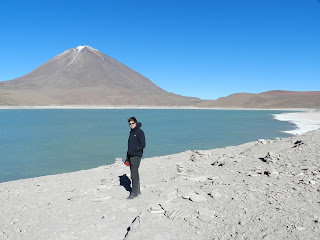
After the geysers, we visited another lake and hot springs that you could swim in.  Even though the warm water looked inviting we opted not to go in since it was still freezing outside and nobody looked happy when they got out of the water.  Our last stop before beginning a very long drive back to Uyuni was Laguna Verde, a lake colored green by arsenic, lead, and copper.

Hot Springs
Laguna Verde

We took a different route back to Uyuni and passed by a few towns and llama farms.  Unfortunately during a large part of the drive we got to listen to the driver’s mp3 player, which seemed to consist of one Bolivian pop song that repeated over and over again.  The main chorus was just someone shouting, “Uyuni! Bolivia! Lima!”  The song still haunts me.


Monday, August 27, 2012

Bolivia: Copacabana


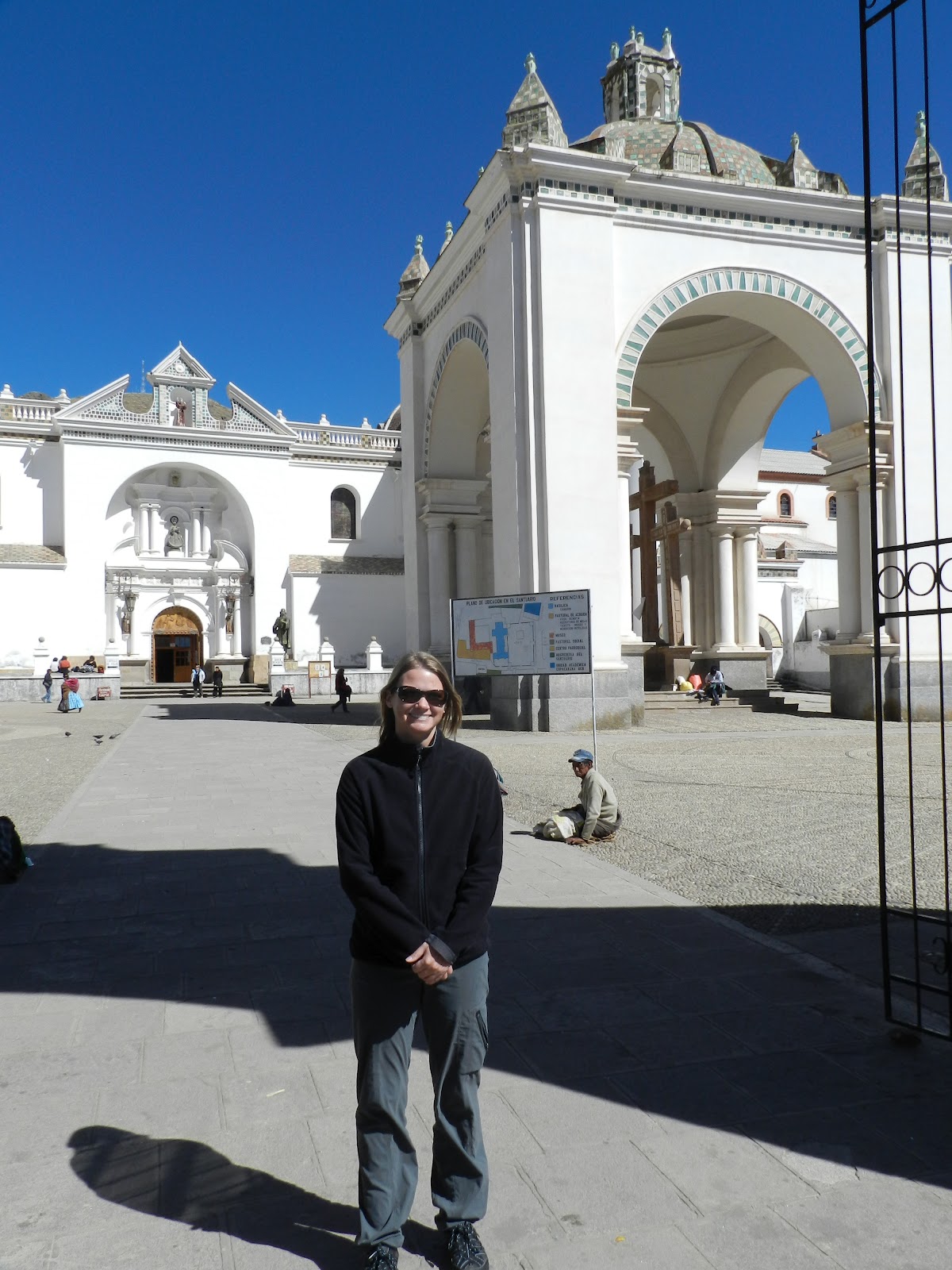
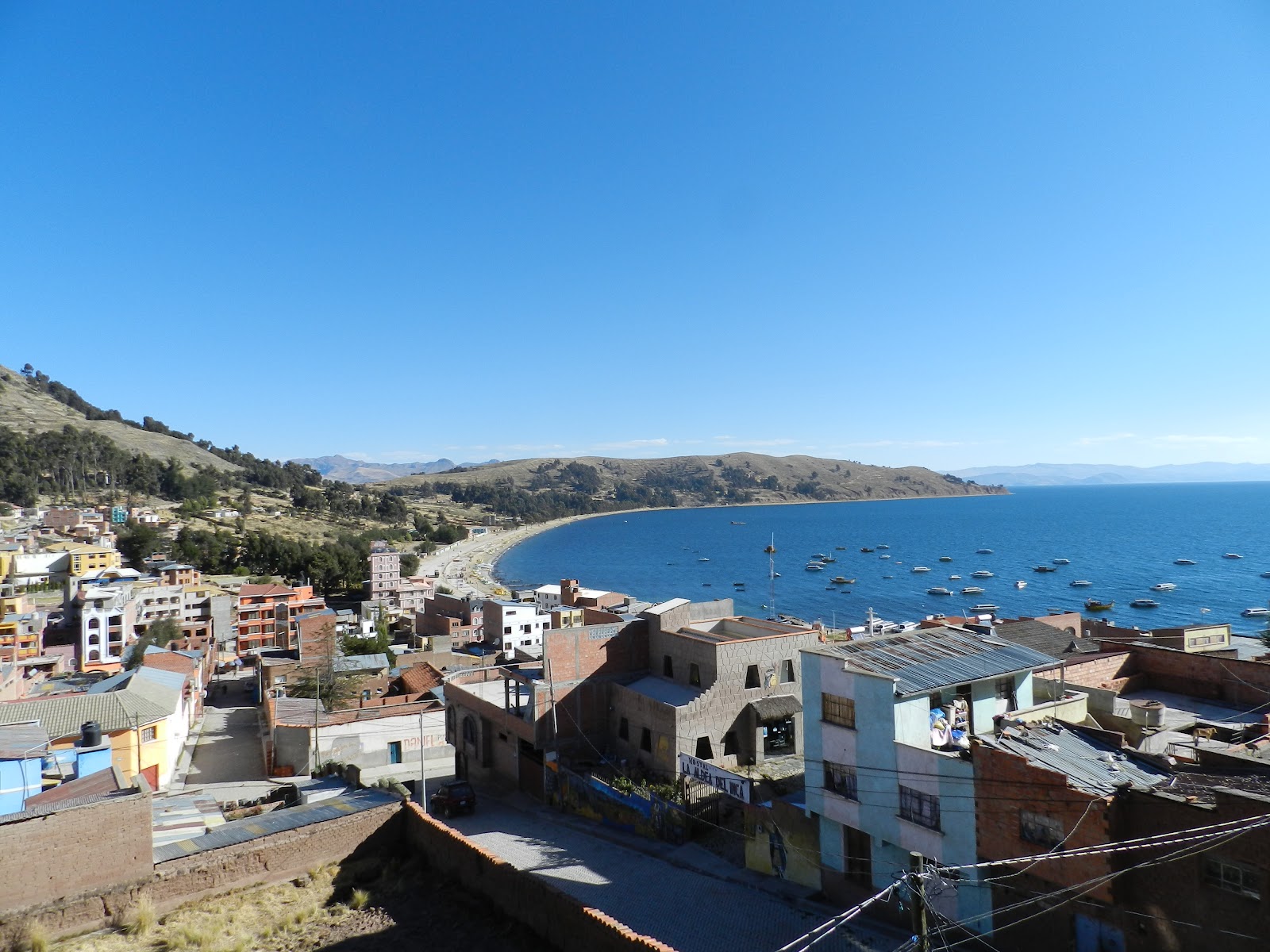
We crossed the border into Bolivia just outside the lakeside town of Copacabana.  Even though its considered a Bolivian "resort" town, Copacabana is pretty small.  There are plenty of tourist shops down a main road and a large cathedral that was nice from the outside.  The highlight of Copacabana was probably our room.  Because of the elevation, it gets very cold in Copacabana at night.  Our hotel had no heating, but guests were invited to use propane heaters in their rooms....from 6pm to 10pm only...and only two heaters were available between about 15 rooms.  We were lucky and managed to get a heater both nights we were there.  The first night, the propane ran out by about 9 though.  I highly doubt they refilled the propane the next day, so in all likelihood, the second night, we were the only ones with any heating at all.


Bolivia Immigration
Simon about to cross the border

Inside the Cathedral
Me standing in the courtyard outside the cathedral


Copacabana and Lake Titicaca


Some turkeys that decided to join us for lunch. This restaurant would not get an "A"
While we were in Copacabana, Bolivians and Peruvians started piling in to the town and lining up to have their cars blessed at the cathedral.  Apparently, this happens every year at the beginning of August.  Before the blessing, the vehicle owners dressed their (unwashed) cars in all kinds of flowers, hats, boas, and small figurines.
All dressed up for the blessing
From Copacabana we took another bus to La Paz.  Crossing Titicaca was especially interesting.  All the passengers piled off and took a small boat.  The bus, and all the luggage with it, was piled on to what can be described as a large raft with a small motor attached.  The bus slowly floated across.

Boats we crossed Lake Titicaca in

Our bus crossing Lake Titicaca

Sunday, August 26, 2012

Peru: Lake Titicaca

We took a bus from Arequipa to Puno to visit Lake Titicaca.  Other than the lake, I don't think there is any reason to visit Puno.  The most interesting place in the town was a large supermarket which I referred to as Peru's Target.  It had everything - food, electronics, clothing, toys, even car tires.  Anyway, during our one full day in Puno, we set off for the port to visit the Floating Islands of Uros.  After a very very slow twenty minute boat ride we arrived in Islas Uros.  I was expecting one big island, but Uros is actually made up of many different islands, with each island having about four or five families on it.  The floating islands are made from reeds that grow in the lake.  Walking on the reed island feels a bit like walking on a trampeline.  The trip to Uros was very touristy.  The community did not seem very authentic and we doubted whether people really live on those particular islands anymore.  However, it was still interesting to get an idea of how people used to live, and still do on reed islands that are more difficult to reach.

Beautiful Puno

A reed restaurant

Welcome to Uros

Simon on the island

A local family

A reed boat

Peru: Arequipa and Colca Canyon


Arequipa was meant to be just a starting point for Colca Canyon but ended up having a few interesting sights of its own.  The city itself, at an elevation of about 7,800 feet, is overlooked by three volcanoes - El Misti, Chachani, and PichuPichu.  It is often referred to as the white city because many of its buildings are made of sillar, a white volcanic stone.  We visited the cathedral and toured a monastery, founded in 1549 (Monasterio Santa Catalina.) 

Tiny doorway
Monasterio Santa Catalina
 We also visited a museum which houses "Juanita," an Incan mummy found in 1995 after a nearby volcanic eruption melted the ice caps that had preserved her body for nearly 550 years.

"Juanita"
Arequipa was also where we had our first introduction to the traditional Peruvian attire as many of the locals (even ones who were not just trying to have tourists take pictures with them for a price) dressed in traditional clothing.  It was easy to find alpacas and llamas in the main square (the Plaza de Armas) with their owners eager for photos. 

Traditional clothes and pet pigeons

Plaza de Armas all dressed up for Peruvian Independence Day
In Arequipa we booked a two day tour to Colca Canyon, the second deepest canyon in the world.  The canyon is quite a ways away and we spent about six hours on a hot, cramped bus.  The bus did have air conditioning, but why use it?  At least there was some relief when we ascended to the higher, colder elevation.  At one point, we reached almost 16,000 feet where we stopped for an awesome view of the area, which included at least four different volcanoes.  

Our awesome ride
Mirador de los Andes, 4,910m
We stopped several other times, mainly so that the locals could sell their crafts and alpaca wool scarves and hats to us.  

Alpacas
Locals selling crafts in the middle of nowhere

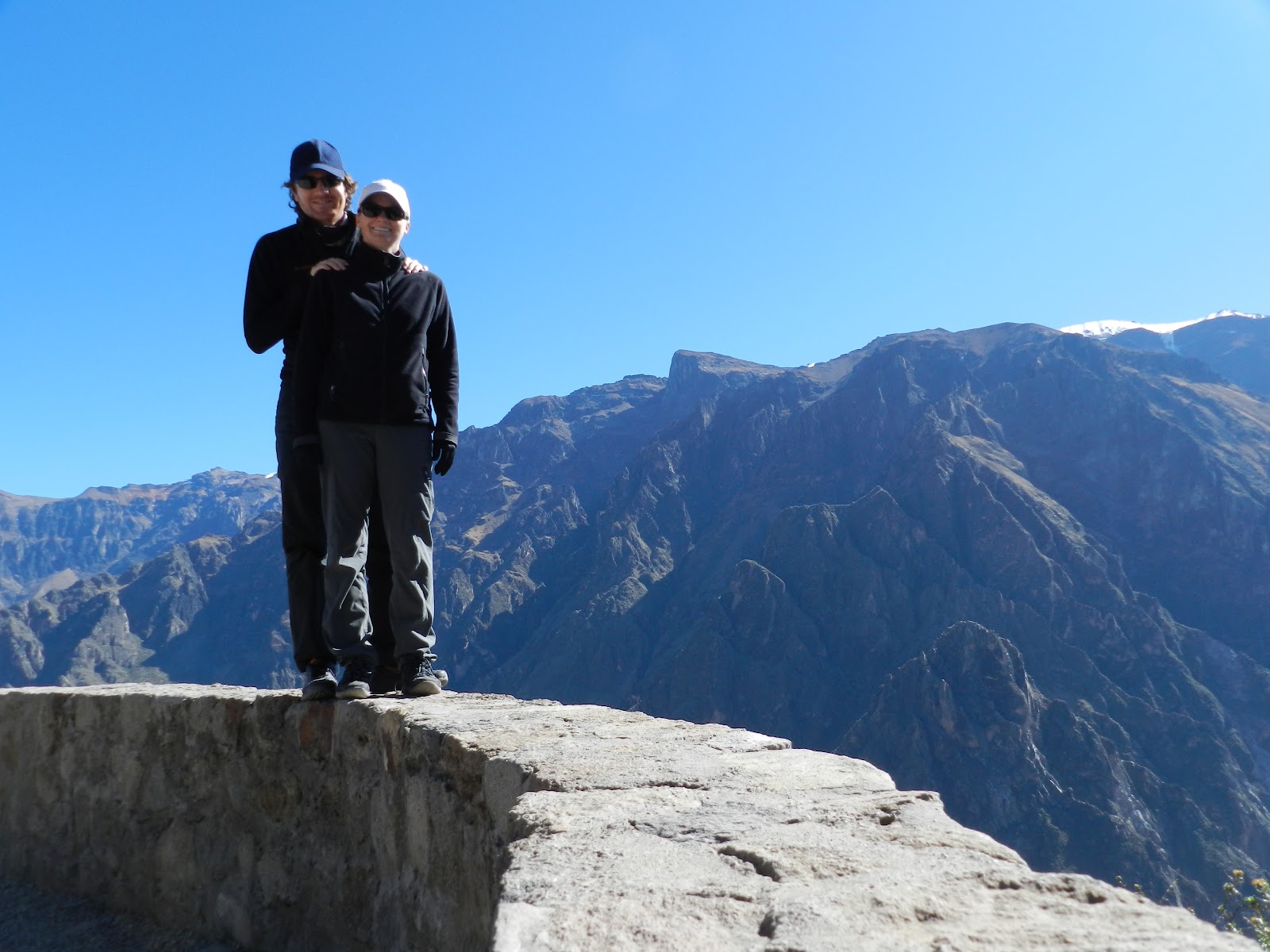
We spent the night in Chivay, a very small town in the Colca Valley.  The room was better than expected but did not have heating and at night temperatures dropped below freezing.  We actually ran the shower for a while hoping that it might heat up the room a little bit.  In the morning we left bright and early for Colca Canyon.  Of course, we again had to stop several times in different towns so that the locals might sell more crafts or be given a sole or two for a picture with their alpaca.  Even though it was quite a trek to get there, Colca Canyon was worth it.  We had just over an hour to sit and take in the beautiful scenery and watch the huge condors soaring through the canyon.


Peru: Lima


We did not have a lot of time in Lima, but enjoyed exploring the historic city center.  We started at the Plaza de Armas and gave ourselves a walking tour, which consisted mostly of churches.  We took a guided tour of Monasterio San Francisco, which has a library containing more than 25,000 ancient texts and catacombs lined with bones.  Lima was our first introduction to Peru and we found Peruvians to be generally welcoming and friendly.  Even taxi drivers seemed honest - for taxi drivers anyway.  We were only called "gringos" once - by a boy yelling from a window.


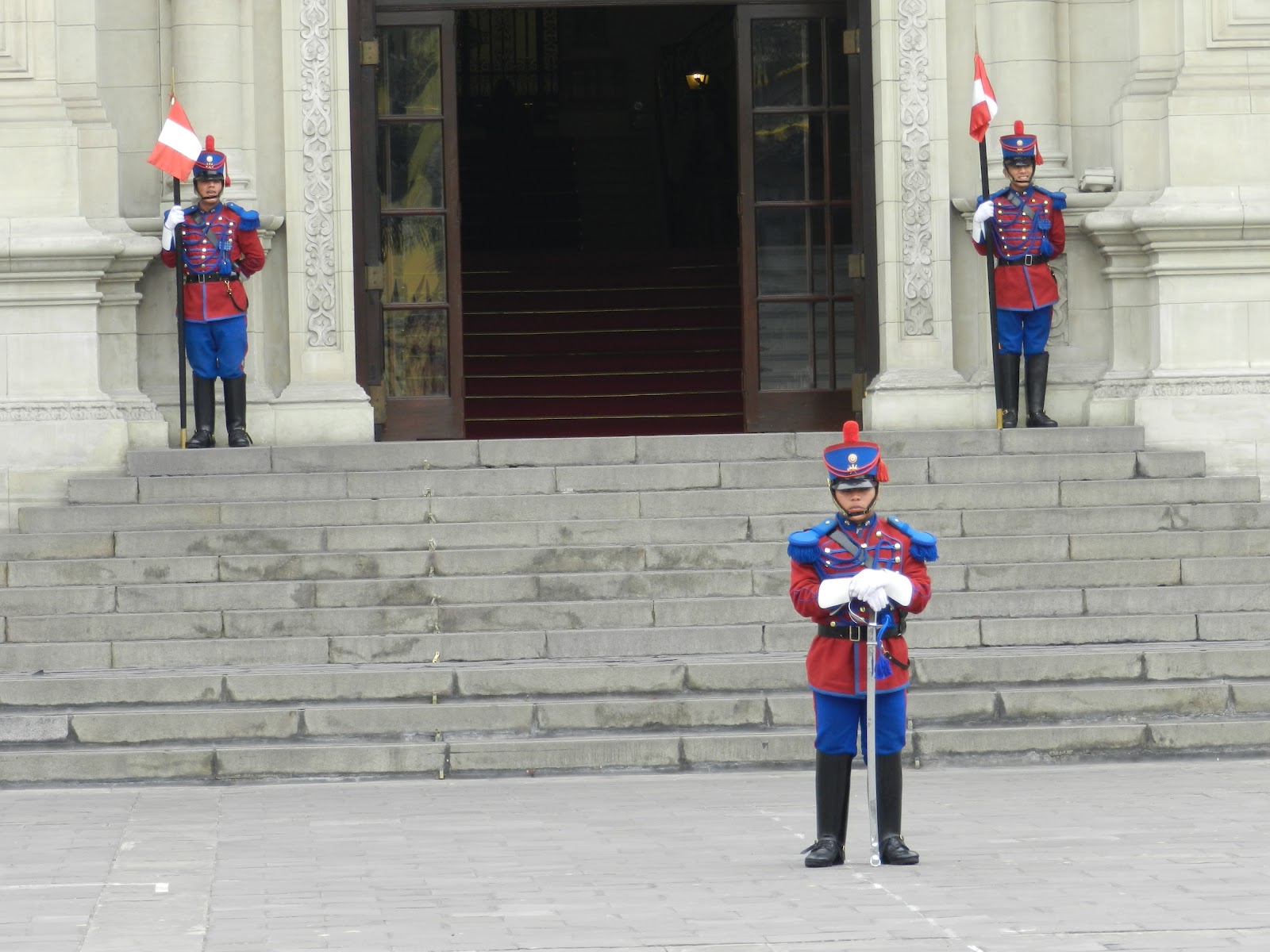
Guards outside the Government Palace
Catacombs of San Francisco Monastery
Plaza de Armas

Recoleta Church of Lima

Government Palace

Wednesday, August 15, 2012

Brazil: Rio and Buzios

On our flight to Rio we were surrounded by Boca Junior football fans.  They were all hyped up for a big football match and it was worse than sitting with fifty five year olds.  They sang their fight song repeatedly, couldn't seem to sit down, and even had a pillow fight.  I had never before been hit with a flying pillow on an airplane.

The weather was gorgeous in Rio when we arrived and we decided to spend a full day on the famous Copacabana Beach with Sugar Loaf Mountain in the distance and Christ the Redeemer looking over us.  It was very surreal.  Much to my surprise, the beach was not packed with people and we only saw a few of the stereotypical beautiful Brazilian women in their string bikinis.  Maybe they come out more in the summer.

The next day we were lucky to have bright blue, nearly cloudless skies when we visited Sugar Loaf Mountain and Christ the Redeemer.  The views from both spots were spectacular.

View of Sugar Loaf Mountain from Corcovado

Simon and Christ the Redeemer

View from Sugar Loaf Mountain

Accommodation in Rio is very expensive, so after hitting the main Rio attractions, we headed to Buzios, a beach resort town about two hours away.  Buzios is on a peninsula and has several different small beaches.  Just a few blocks from our hotel was a nice, quiet strip of sand where we spent the majority of eight days.  We ventured to other beaches a couple of times and found them to be crowded and full of vendors pushing their goods on people.  One tropical storm rolled through while we were in Buzios and brought an amazing lightning show.  The same night, we spotted a lone sea turtle swimming around the harbor.  The only downside of Buzios was that since it is a resort town, all of the restaurants are quite pricey.  This meant that we had a lot of meals at Subway.

On "our" beach

Sandcastles

We had a few more days in Rio before flying to Peru.  When we returned from Buzios, the weather had changed.  Cloudy skies constantly threatened rain.  We were glad that we had gotten our nice city views before we went to Buzios.  On our last days in Rio, we visited Ipanema Beach, walked along Copacabana again, and did a lot people watching.

I had been a bit nervous about crime in Rio before we got there, but we just stuck to the tourist areas and stayed in at night, and I never felt unsafe.  I was quite pleased to have visited Rio without getting mugged.  
With mountains, rainforest, and beaches, Rio really is an awesome city. 

Copacabana Boardwalk

Cloudy day on Ipanema Beach