Sunday, August 26, 2012

Peru: Arequipa and Colca Canyon


Arequipa was meant to be just a starting point for Colca Canyon but ended up having a few interesting sights of its own.  The city itself, at an elevation of about 7,800 feet, is overlooked by three volcanoes - El Misti, Chachani, and PichuPichu.  It is often referred to as the white city because many of its buildings are made of sillar, a white volcanic stone.  We visited the cathedral and toured a monastery, founded in 1549 (Monasterio Santa Catalina.) 

Tiny doorway
Monasterio Santa Catalina
 We also visited a museum which houses "Juanita," an Incan mummy found in 1995 after a nearby volcanic eruption melted the ice caps that had preserved her body for nearly 550 years.

"Juanita"
Arequipa was also where we had our first introduction to the traditional Peruvian attire as many of the locals (even ones who were not just trying to have tourists take pictures with them for a price) dressed in traditional clothing.  It was easy to find alpacas and llamas in the main square (the Plaza de Armas) with their owners eager for photos. 

Traditional clothes and pet pigeons

Plaza de Armas all dressed up for Peruvian Independence Day
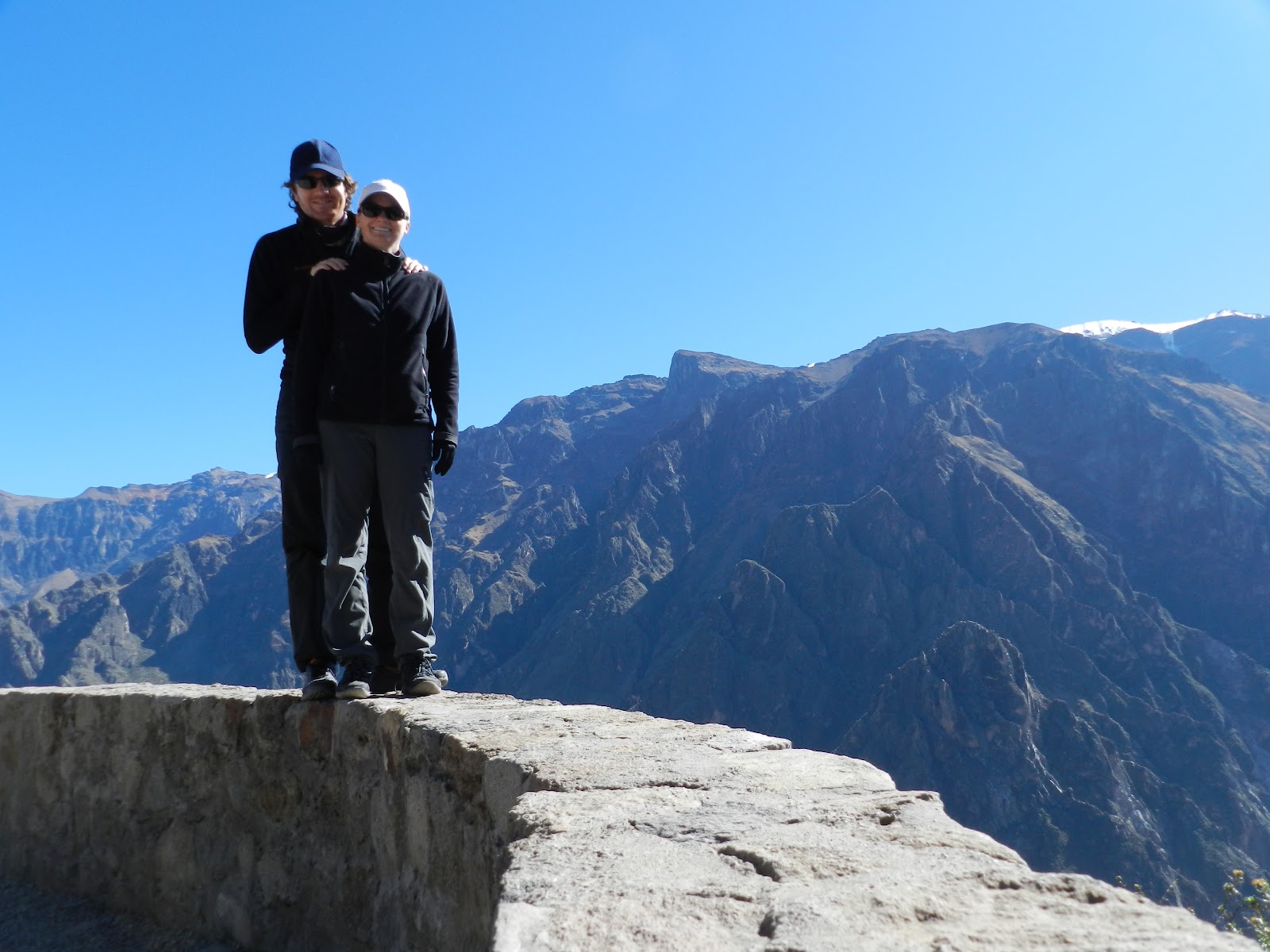
In Arequipa we booked a two day tour to Colca Canyon, the second deepest canyon in the world.  The canyon is quite a ways away and we spent about six hours on a hot, cramped bus.  The bus did have air conditioning, but why use it?  At least there was some relief when we ascended to the higher, colder elevation.  At one point, we reached almost 16,000 feet where we stopped for an awesome view of the area, which included at least four different volcanoes.  

Our awesome ride
Mirador de los Andes, 4,910m
We stopped several other times, mainly so that the locals could sell their crafts and alpaca wool scarves and hats to us.  

Alpacas
Locals selling crafts in the middle of nowhere

We spent the night in Chivay, a very small town in the Colca Valley.  The room was better than expected but did not have heating and at night temperatures dropped below freezing.  We actually ran the shower for a while hoping that it might heat up the room a little bit.  In the morning we left bright and early for Colca Canyon.  Of course, we again had to stop several times in different towns so that the locals might sell more crafts or be given a sole or two for a picture with their alpaca.  Even though it was quite a trek to get there, Colca Canyon was worth it.  We had just over an hour to sit and take in the beautiful scenery and watch the huge condors soaring through the canyon.


Peru: Lima


We did not have a lot of time in Lima, but enjoyed exploring the historic city center.  We started at the Plaza de Armas and gave ourselves a walking tour, which consisted mostly of churches.  We took a guided tour of Monasterio San Francisco, which has a library containing more than 25,000 ancient texts and catacombs lined with bones.  Lima was our first introduction to Peru and we found Peruvians to be generally welcoming and friendly.  Even taxi drivers seemed honest - for taxi drivers anyway.  We were only called "gringos" once - by a boy yelling from a window.


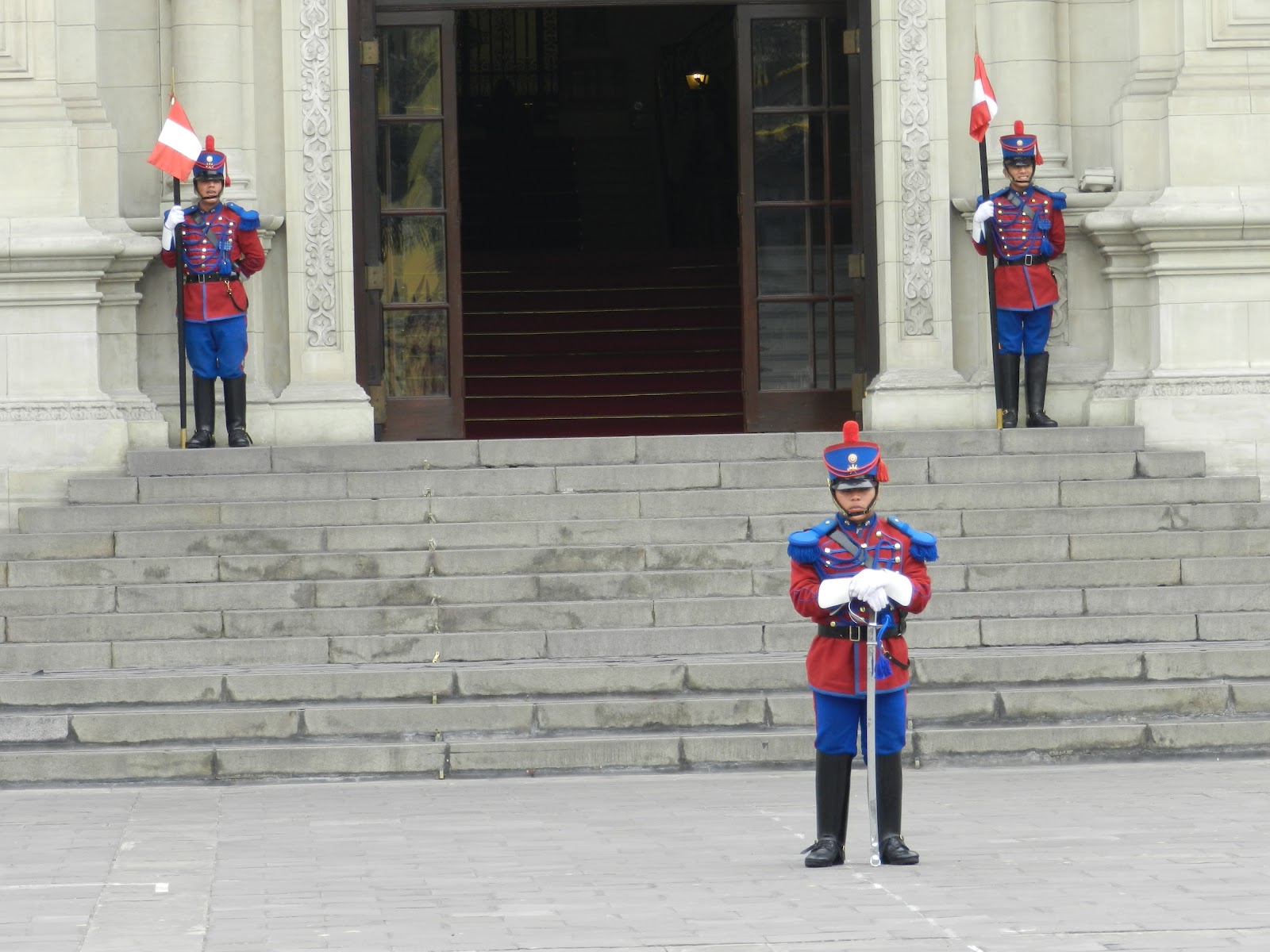
Guards outside the Government Palace
Catacombs of San Francisco Monastery
Plaza de Armas

Recoleta Church of Lima

Government Palace

Wednesday, August 15, 2012

Brazil: Rio and Buzios

On our flight to Rio we were surrounded by Boca Junior football fans.  They were all hyped up for a big football match and it was worse than sitting with fifty five year olds.  They sang their fight song repeatedly, couldn't seem to sit down, and even had a pillow fight.  I had never before been hit with a flying pillow on an airplane.

The weather was gorgeous in Rio when we arrived and we decided to spend a full day on the famous Copacabana Beach with Sugar Loaf Mountain in the distance and Christ the Redeemer looking over us.  It was very surreal.  Much to my surprise, the beach was not packed with people and we only saw a few of the stereotypical beautiful Brazilian women in their string bikinis.  Maybe they come out more in the summer.

The next day we were lucky to have bright blue, nearly cloudless skies when we visited Sugar Loaf Mountain and Christ the Redeemer.  The views from both spots were spectacular.

View of Sugar Loaf Mountain from Corcovado

Simon and Christ the Redeemer

View from Sugar Loaf Mountain

Accommodation in Rio is very expensive, so after hitting the main Rio attractions, we headed to Buzios, a beach resort town about two hours away.  Buzios is on a peninsula and has several different small beaches.  Just a few blocks from our hotel was a nice, quiet strip of sand where we spent the majority of eight days.  We ventured to other beaches a couple of times and found them to be crowded and full of vendors pushing their goods on people.  One tropical storm rolled through while we were in Buzios and brought an amazing lightning show.  The same night, we spotted a lone sea turtle swimming around the harbor.  The only downside of Buzios was that since it is a resort town, all of the restaurants are quite pricey.  This meant that we had a lot of meals at Subway.

On "our" beach

Sandcastles

We had a few more days in Rio before flying to Peru.  When we returned from Buzios, the weather had changed.  Cloudy skies constantly threatened rain.  We were glad that we had gotten our nice city views before we went to Buzios.  On our last days in Rio, we visited Ipanema Beach, walked along Copacabana again, and did a lot people watching.

I had been a bit nervous about crime in Rio before we got there, but we just stuck to the tourist areas and stayed in at night, and I never felt unsafe.  I was quite pleased to have visited Rio without getting mugged.  
With mountains, rainforest, and beaches, Rio really is an awesome city. 

Copacabana Boardwalk

Cloudy day on Ipanema Beach


Monday, July 23, 2012

Uruguay: Montevideo and Colonia

Uruguay was not in our original plans, and not even in the plans when we arrived in South America.  We had thought we would do some more traveling within Argentina, but once we started looking at distances, bus times, and the costs of flights, it seemed most reasonable to just head across the river and visit Uruguay.  So, we booked a flight from Iguazu to Montevideo, connecting in Buenos Aires.  Unfortunately, the flight from Buenos Aires was delayed and we sat waiting to board the 45 minute flight to Montevideo for more than two hours.

After an hour on a local bus from the airport into the city, we found our way to our hostel, conveniently located in Plaza de Independencia, close to the tourist highlights.  For the great location, we paid the price of listening to a constant flow of buses coming and going right outside our window.  The room was okay except that it did not have heating and it got pretty cold.  We were sleeping with our beanies on.
The weather was poor while we were in Montevideo and it rained quite a bit.  If the weather had been nice, we probably would have enjoyed the city more.  Even so, we did enjoy getting to see a new place, and visiting a new country.


For the most part, we just wandered around the city, visiting various markets, museums, and buildings of interest.  It must not have been tourist season in Montevideo since most of the museums we visited (or tried to visit) were either closed or empty except for us.  In the Gaucho Museum, we looked around while the cleaning crew vacuumed and dusted.  In the Gurvich art gallery, we had a private viewing.  In the Exposicion Subte, we were asked to leave because, despite their open doors, they were apparently closed.  The only tourist attraction we visited where we were not alone was the Teatro Solis, Montevideo's oldest theater.  The theatre was built in 1856 and is considered the most important theatre in the city.  We took a guided tour through its brilliantly decorated foyers and multiple stage areas.

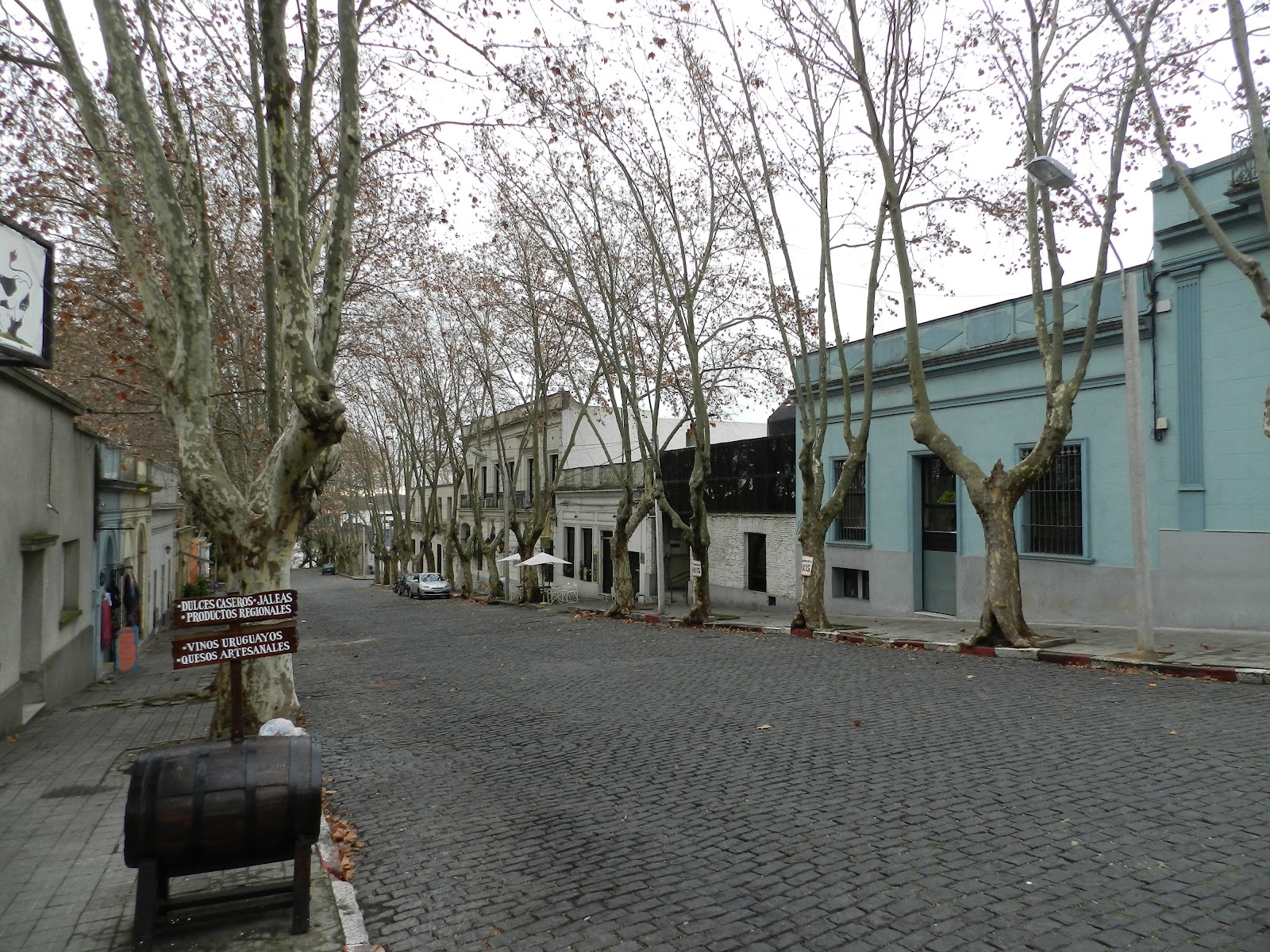
Other highlights of our brief visit to Montevideo included the discovery of a shop selling declicious empanadas and cakes, a wander around the "Old Town" with its 19th century buildings, the Mercado del Puerto, full of bustling restaurants and gift shops, and a private dining experience at McDonald's.  It is very strange to sit in a McDonald's with nobody else around.

Gaucho Museum
Gaucho Museum Exhibit
Montevideo Coastline
Palacio Salvo
Teatro Solis
Teatro Solis Interior
Rather than flying straight back to Buenos Aires from Montevideo, we took a bus a few hours north to the historic town of Colonia.  Because of the time of year, the town was quiet and a lot of places were closed.  Except for a very small area, it almost felt like a ghost town.  Although some of the old buildings, built in either a Portuguese or Spanish style depending on who occupied the town at the time, were interesting, overall we were unimpressed with Colonia.  Our experience might have been quite different during another time of year.  After only a little over an hour, we walked to the ferry terminal where we would take a boat back to Buenos Aires.


Iguazu Falls


Over three days in the Iguazu area we visited Tres Fronteras and both the Brazilian and Argentinian sides of the falls.  The falls, taller and twice as wide as Niagara, were spectacular, but first, I must describe getting to Puerto Iguazu.  To get to Puerto Iguazu from Buenos Aires we had a choice of flying or taking a bus.  The bus was about half the price so despite my concerns about an 18 hour bus ride (that's right, 18 hours) we decided to travel by land.  The bus left Buenos Aires at 2:15 pm.  The size of the seats and leg room is comparable to business class on a plane (now that I know what that's like after our lucky upgrade to NZ.)  For the first hour, the tvs played only advertisements for a ski resort in Patagonia.  Eventually, the movies started and even though there were headphone jacks above every seat they thought it was a good idea to play the movies out loud.  There was not much we could do but try to enjoy the Spanish dubbed Mission Impossible and Journey 2.  I guess it doesn't say much for the movies when they were pretty easy to follow even though I could only understand a few words and phrases.  Those two treats were followed by Man on Fire in English (hurray!).  However, the next one, a Bollywood film in Spanish, was not something I would have enjoyed in any language.  By that point it was time to settle down and attempt to sleep on our partially reclining chairs anyway.  I will say that I was impressed with the amount of food we were given on the bus.  We expected dinner and around 5:00 pm we were given ham and cheese croissant sandwiches.  We were underwhelmed.  However, around 9pm, more food came out.  This time it was a full meal of salad, pasta, bread, and dessert, along with wine or soda.  Apparently the croissants were a snack.  We had learned in Buenos Aires that Argentinians are on a much later time schedule than we are but did not realize that would carry over to the bus.  So, for almost 18 hours, we ate, watched movies, and slept on and off.  It was not a whole lot worse than a long flight, but I still would prefer not to do it again.
Ready for a long bus ride
When we arrived in Puerto Iguazu, the nearest town to Iguazu Falls on the Argentinian side, we checked in to our hostel and got ourselves situated.  We decided to wait until the following day to visit the falls so that we would be more rested. So we wandered about the town, which is actually larger than I expected, and visited Tres Fronteras.  At this location, Argentina, Brazil, and Paraguay can all be seen from one spot.
Tres Fronteras

Tres Fronteras Monument
The following day we boarded a local bus to the Iguazu National Park on the Argentinian side.  From the entrance, a small train (similar to one at Disneyland) takes you out to the start of the trails.  There is an upper circuit and lower circuit.  The upper circuit follows walkways and bridges over the tops of the waterfalls.  You can literally look straight down some of the falls.  The lower circuit, for the most part, is a bit further off and allows a more expansive view of the falls from below.  There is one section of the lower circuit that goes right out to the bottom of one of the waterfalls, soaking anyone brave enough to get close.  After walking both the upper and lower circuits we boarded the little train again and went for a view of the Garganta del Diablo (Devil's Throat).  The Devil's Throat is a U-shaped waterfall with water flowing in from three sides, creating the most powerful deluge of water I have ever seen.  The force of the falling water is so strong that the water explodes back up as if it were an erupting volcano.  There is always a 100 foot cloud of spray over the Devil's Throat because of the force of the water.    
Choo! Choo! Ready to ride the train to the falls
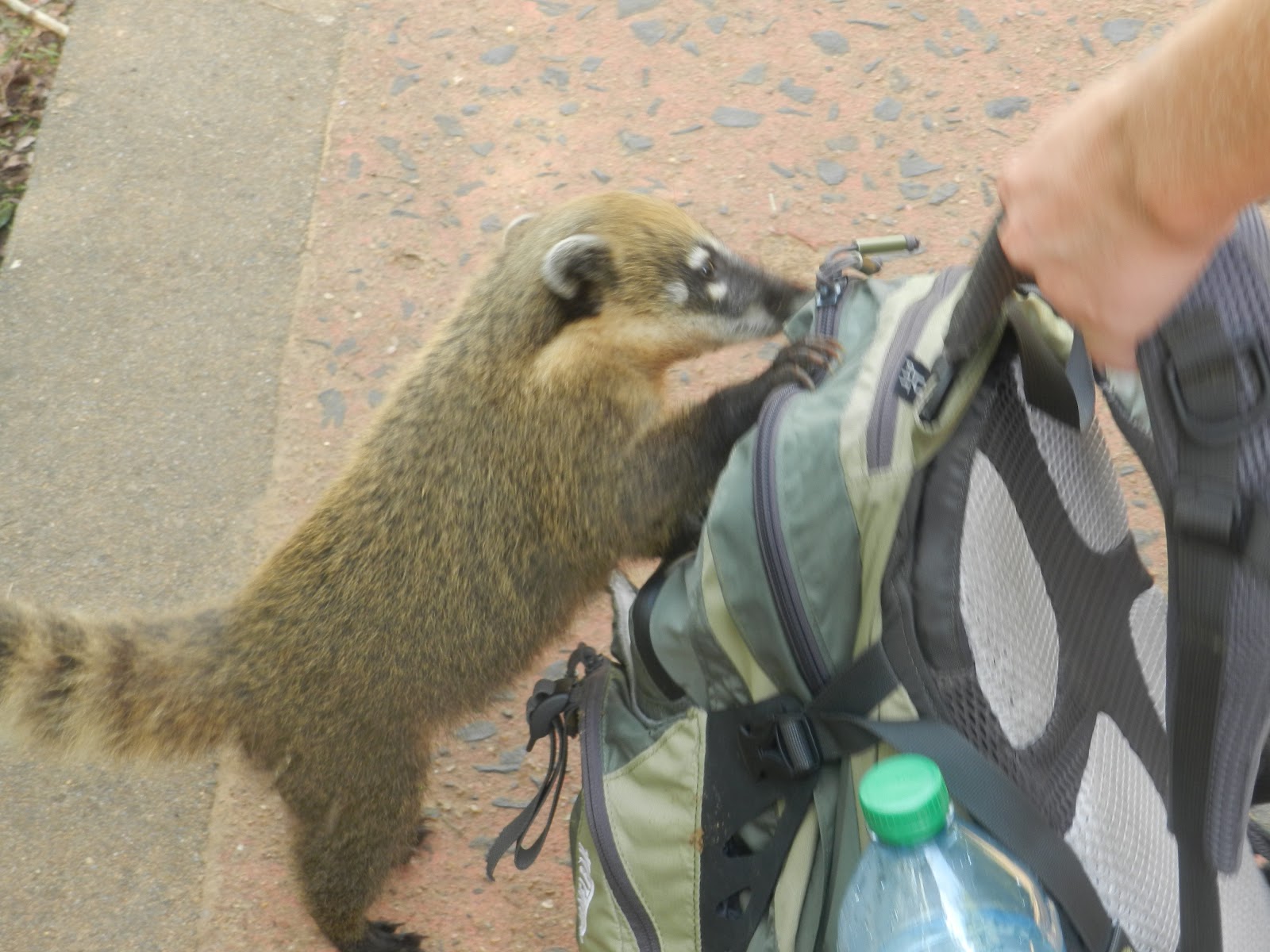
Coati - These guys were everywhere


Coati investigating my backpack
Simon and I at the Devil's Throat
The Devil's Throat
The Devil's Throat
Walkway to the Devil's Throat


Panoramic View
Waterfalls Up Close


The next day we boarded a tour bus to visit the Brazil side of the falls. The hostel owner told us we didn't really need to go to Brazil because the Argentinian side was the best, but we thought we were so close and should really see both.  The Brazilian side was just as breathtaking and incredible as the Argentinian side.  If we had not gone, we really would have been doing ourselves an injustice.  While we got right on top of some of the falls in Argentina, in Brazil we were treated to a panoramic view of the entire length of the expansive falls.  The two sides are incomparable and are both worth a visit.


Buenos Aires


We arrived in Buenos Aires early on June 20 after an overnight flight from Houston.  Of course we didn't sleep much so we were dead tired when we arrived.  Once we got to the hostel though, we had no desire to nap.  The room was awful...stains on the walls and sheets, the window did not shut, and when we went out, the door had to be locked with a padlock.  The shared bathrooms were not any better...toilet seats were broken off and doors didn't shut properly.  Needless to say, one of our tasks for the day was to find somewhere else to stay the next night.

Hostel staff trying (unsuccessfully) to shut the window
Putting thoughts of the filthy room aside, we headed out to explore the city.  We walked toward Plaza de Mayo and visited the Casa Rosada.  From Casa Rosada we walked along Avenue de Mayo to the Plaza de Congreso.  Along the way, we crossed Avenue 9 de Julio, which at 140 meters and up to seven lanes of traffic in each direction, is one of the widest avenues in the world.  

Avenue 9 de Julio
Casa Rosada
We found it odd as we walked around the city that so many shops were closed and the streets seemed quiet.  Of course, Starbucks was open.  So, we went inside for a break and a pick me up.  I attempted to place my order in Spanish and the girl taking my order smirked a little.  When I started to struggle, she revealed that she speaks perfect English.  We asked about the closed shops, etc. and learned that we had arrived on a holiday - Dia de la Bandera Nacional.


On our second day in Buenos Aires, we checked out of the hole of a hostel we were in and moved in to a much cleaner place down the road.  After settling in, we headed out for another day of sight seeing.  This time, we started out by walking through Puerto Madero and the old docks.  We continued on to Plaza de San Martin and the Falklands War Memorial.  From there, we walked to the Recoleta neighborhood and visited the cemetary and nearby Iglesia del Pilar.  The Cementerio de la Recoleta cemetary is huge and full of massive, ornate tombs.  Eva Peron is buried there, making it a popular place for visitors.  After Recoleta, we started to head back in the direction of San Telmo, the neighborhood we were staying in, but we took the long route, passing the beautiful Teatro Colon and the Obelisco in the Plaza de Republica along the way. 

Puerto Madera

Recoleta Cemetary


After five and a half hours of solid walking, we decided that it was as good a night as any to treat ourselves to a meal out.  On recommendation from my cousin, former BsAs resident, we went to Siga La Vaca for a steak dinner.  For only about $24, we were given all the meat we could eat (beef, chicken, lamb, pork), all you can eat salad bar, bread, dessert and either a full pitcher of beer or a bottle of wine (each).  We both had several servings of steak, along with various other delicious bits.  We were so full that the next day we didn't eat a thing until late afternoon.


We got a late start on our third day, but spent the afternoon visiting the La Boca neighborhood.  As we headed out, we walked past Plaza Dorrego and stopped to watch the tango dancers putting on a show for the cafe patrons.  We continued on our long walk along busy streets and through parks into La Boca.  La Boca is a lively (and very touristy) neighborhood full of brightly colored buildings. Restaurants and gift shops line the pedestrianized roads.  On the way, we also passed by the Boca Juniors football stadium, which obviously was more interesting to Simon than to me.  I had never even heard of the Boca Juniors, but I got to know some of their fans better than I would have liked to later on (more to come in the Rio post).   


The next day we boarded our 18 hour bus to Iguazu Falls.  We returned to Buenos Aires about a week later after also visiting Uruguay.  We decided to stay in a different neighborhood so that we would see more of the city.  Unfortunately, during the week we were away, the blue skies had gone gray and rain was never far off.  I also had a pretty bad cold - probably from our freezing room in Montevideo.  Fortunately, we were staying in a pretty nice place and were quite happy to just have a couple days of doing hardly anything but using the internet and watching movies.  

On our last day, our flight was not until the evening so we stashed our bags with reception and finally wandered around the neighborhood and nearby gardens.  On our way back, we had lunch in Havanna, also recommended by my cousin, and for dessert, sampled some alfajores, a favorite treat in Argentina.  Delicious.  We ended up buying a whole box of them and that box did not last long.